Part 3 of 3 in The Steady Way to Begin a New Year
Back in January, I wrote about how our Western culture has a strange pressure around reinventing ourselves in the dead of winter. We look around and see bare trees and more dark than light yet we are supposed to spring to life with a New Year’s vigor while steeped in this quiet winter energy. I invited you to instead choose an intention for your year, and start smaller than you think you should… One pushup. One page of a journal. One minute of meditation.
Then, in the summer we explored the effort paradox: why we're wired to avoid hard things but also to value them (yet another strange inconsistency), and why doing "slightly hard" things is the sweet spot where actual growth happens.
Now it's Fall. In Chinese medicine, autumn belongs to the Metal element. It's the season of harvesting and reaping the rewards of your labor. It’s also about consolidating your energy and of letting go... remembering what has worked, reassessing and releasing what is not or is no longer important, like the way the trees are dropping their leaves.

So it’s a good time to reflect and ask...
How is your intention holding up?
Maybe your January intention is still going strong (if so, please celebrate! You’re among the minority)! Or maybe it quietly faded away somewhere around Spring Break or summer vacation. Either way, a friendly reminder: you don't need January. You don't need a Monday. You don’t need a perfect opportunity, a clean slate, or the “right time”. The only moment change ever actually happens is in this one!
At the end of Part 2, I promised we'd bring it all together: what it looks like to build reliable momentum around these concepts and philosophies, not just a single habit, and what Heroic living means when things get challenging. How do you sustainably build this into your identity and how does that affect your life?
Knowing isn't the Problem.
Many of my clients share the struggles they are facing in their life with me. When we get to the areas they feel stuck in they often mention the word “should”. “I should be exercising more”... “I should get organized”... I should do this, I should do that.
When we are not taking the actions we know will benefit us it usually boils down to the simple fact that we don’t feel like it. That feeling is tied to our brain’s bias towards energy conservation. But that conservation bias is an outdated (albeit deeply embedded) survival program. In reality, if you’re reading this, you're not at risk of running out of fuel.
Our logical brain knows but our emotional brain says NO, which often leads to us NOT doing the thing.
So our mind’s dialogue tends to insert "shoulds". But be careful of “shoulding all over yourself” (sorry - I had to say it  ) Doing so creates internal guilt and shame that weighs you down even more. It’s not actually motivating at all!
So what does work?
Simply starting... and starting small.
The cool thing is that if you start, and especially if you keep your one pushup (or whatever your practice is) to roughly the same time of the day - you adapt very quickly and start to expect it around the same time the next day. Humans adapt very easily to new things. Even things we don’t initially like doing.
Remember the brain changes through repetition, not information. Neurons that fire together wire together. Insight, or knowing what to do or where to go, is the map (logic). The act of practicing, moving toward your destination, no matter how small of a step is what creates the trail (literally hard wiring and reinforcing the neural connections).
From "Should" to "Want"
In Part 2 we talked about moving toward something instead of running away from something.
"Should" is avoidance-based (running away) language. It carries fear, guilt, and obligation - you’re trying to escape a bad feeling. Language is powerful and the way we term things matters. Avoidance-based language creates pressure and stress, which your nervous system responds to accordingly. “Should energy” is an attempt to temporarily motivate ourselves. I reiterate - it is temporary. Avoidance motivation runs out after the discomfort fades a little. By running away, you are not heading to a specific place, just away from the pain and discomfort.
What behavioral science shows us is that approach-based motivation is much more sustainable. It’s tied to something you are building towards (like an identity). "I see it. That's not who I want to be. I want something different. I want ________." That's a moving-toward statement, and your brain responds differently.
In the spirit of the season (autumn) let go of the "shoulds" and make room for what you actually want.
From Habit to Identity to Areté
In Part 1, I wrote that small actions change identity. One pushup becomes "I am someone who exercises." One page becomes "I am someone who reads."
Now, we're taking that one step further. When enough of those identities line up, across your body, your contribution, and your relationships (energy, work, and love), they become something bigger: they become your character.
The ancient Greeks had a word for character at its best: Areté. It's often translated as "virtue" or "excellence." In the Heroic framework we think of it as expressing the best version of yourself, moment to moment to moment. And here's the key... Areté isn't something you achieve once and check off. It's practiced daily. As Will Durant summarized Aristotle,
“We are what we repeatedly do. Excellence, then, is not an act, but a habit”.

This is the heart of the Heroic framework I use in my coaching: closing the gap between who you're capable of being and who you're actually being, right now. Not with harsh self-criticism, but from accepting what is and also being excited for what can be.
So what does Heroic living look like when the challenges stack up? When you have a sick kid, a deadline, and an aging parent... and then the old you (the pattern you swore you were done with) shows back up as if it was never outgrown?
It is not about having a perfect day every day. It's about pausing for a minute and asking, right in the middle of the mess:
- Who do I want to be right now?
- What needs to be done next?
And then taking that next small, slightly hard step as the identity of the person you want to be.
One strategy I find very helpful is Win, Learn, Optimize.
At the end of a hard day, ask yourself:
- What did I do well? (Win)
- What did I learn? (Learn)
- What's one thing I'll do better tomorrow? (Optimize)
Don't beat yourself up. Just take an honest inventory and move forward.

This year one of my ‘one pushups’ was first reaching for nuts or yogurt when I wanted tortilla chips and salsa. I’ve had a weak spot for chips and salsa for as long as I can remember  . Telling myself I ‘shouldn’t’ only temporarily worked some of the time. What worked was deciding I wanted to feel better, and deciding to go for the protein before the carbs. Sometimes the chips still win though. That goes into the "learn" category. But most of the time now I get a little protein to soothe my hunger first. "I'm someone who chooses healthy options first".
And I'd genuinely love to hear your intention, and how it's holding up. Email me at michael at headway health dot com.
An Invitation
Over the years, I’ve realized that it isn’t always a missing piece of information that people need. Many people already know what to do. More often than not, what people need is structure, support, and someone paying full attention while they actually do it.
That's why I built Rise, a 6-session, one-on-one coaching program built around Energy, Work, and Love. We start by getting honest about where you are and who you want to become, then build the tools, structure, and small daily practices to close the gap. You get a personal 55 page workbook to keep and the option to meet in person in Austin or Buda, or by phone or video.
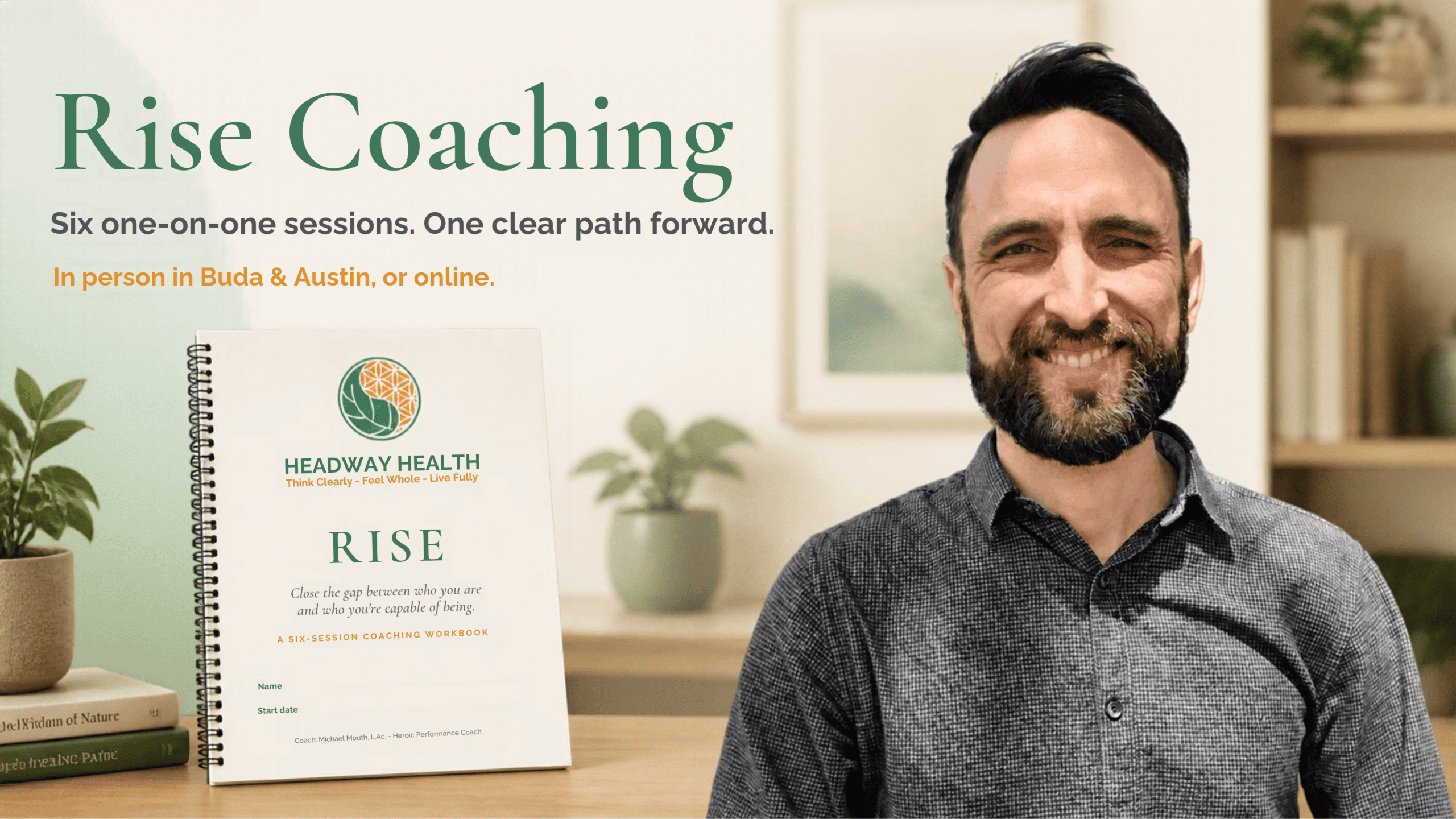
If any of this calls out to you, I'd love to talk. Book a free 20-minute no pressure discovery call where we just have a real conversation about where you are and whether Rise is a good fit.
You don't need January.
You just need the next decision and a small action step to create momentum.
