


The Winter Rests in January … Do You?
Sometime in mid-January, a familiar feeling tends to show up. The decorations are down, the calendar is new, and yet there is already a quiet sense of pressure. Gyms are starting to thin out a little, goals start to be questioned, and 2026 has begun to ask for more honesty. Part of you might not be quite ready to launch and that’s okay. This isn’t laziness. It’s what happens when goals driven by intensity and excitement, rather than alignment and meaning, are beginning to reveal themselves.

There is something strange about this time of year. Nothing in nature is actually beginning, yet we tell ourselves this is the moment to reinvent everything. Trees are bare. The earth is quiet and the sun is low. Yet still, we are expected to sprint forward as if spring has already arrived. If that tension feels familiar, you are not behind. You are human! And you may actually be right on time.
This isn’t about pushing harder or doing more. It’s about understanding how change actually happens, and learning to work with your brain instead of against it.
This is part one of a three part series on how to inner-stand change and how to make change actually happen!
There is an elephant in many living rooms right now. For those who set New Year’s resolutions, about half of Americans, roughly 22% fail within the first week. Within two to three months, about half have stopped. By the end of the year, nearly 70% fail altogether.
Oof.
By definition, a “resolution” comes from a word meaning to “loosen uncertainty” or “resolve confusion”. After learning that, it actually makes the word feel even less inspiring to me! Resolutions have a connotation of being permanent, all-or-nothing, and unforgiving. No wonder so many people quietly abandon them or don’t set them – after-all the safest way not to fail is not to try at all.
And maybe that’s why I stopped making New Year’s resolutions years ago.
When does the actual New Year start?
By the way, celebrating January 1st as the “New Year” is actually a relatively modern idea. It wasn’t widely adopted until the 1500s. In ancient Rome, January 1st was largely a governmental marker, a time for taxes, and preparing for war. Historically, most cultures recognized the new year in the spring, when life visibly returns to the earth – which makes sense. Declaring renewal in the dead of winter when nothing around us looks new, can feel disconnected and unmotivating. In nature, winter has never been about explosive beginnings. It has always been about preparation.
Winter in Chinese medicine

In Chinese Medicine and Taoist philosophy, winter corresponds to the Water element. Water is associated with stillness, reflection, listening, and depth. Even here in Central Texas, where winters are mild, the season naturally invites us to slow down. Yet modern Western culture often ignores this rhythm, pushing constant productivity while undervaluing rest and recuperation. Winter asks something different. It invites us to turn inward, to reflect and accept what was, to appreciate what is, to let go of stories and imagined future problems, and instead to quietly consider what we want to grow when the time is right. This season is not about forcing change. It is about creating the clarity that makes change possible.
Instead of resolutions, I usually do two things. I choose a single word to guide my year, and I set intention that I physically write down.
Interestingly, the word intention comes from the Latin intentio, meaning stretching, purpose, or aim. That feels very different than resolution. Intention suggests direction rather than perfection.
So let’s talk about moving forward. Not perfectly, but effectively.
Set an intention. Write it down.
Do you intend to read more books? Journal more? Be more financially responsible? Take better care of your body because you are tired of feeling sluggish?
Great. Write it down!
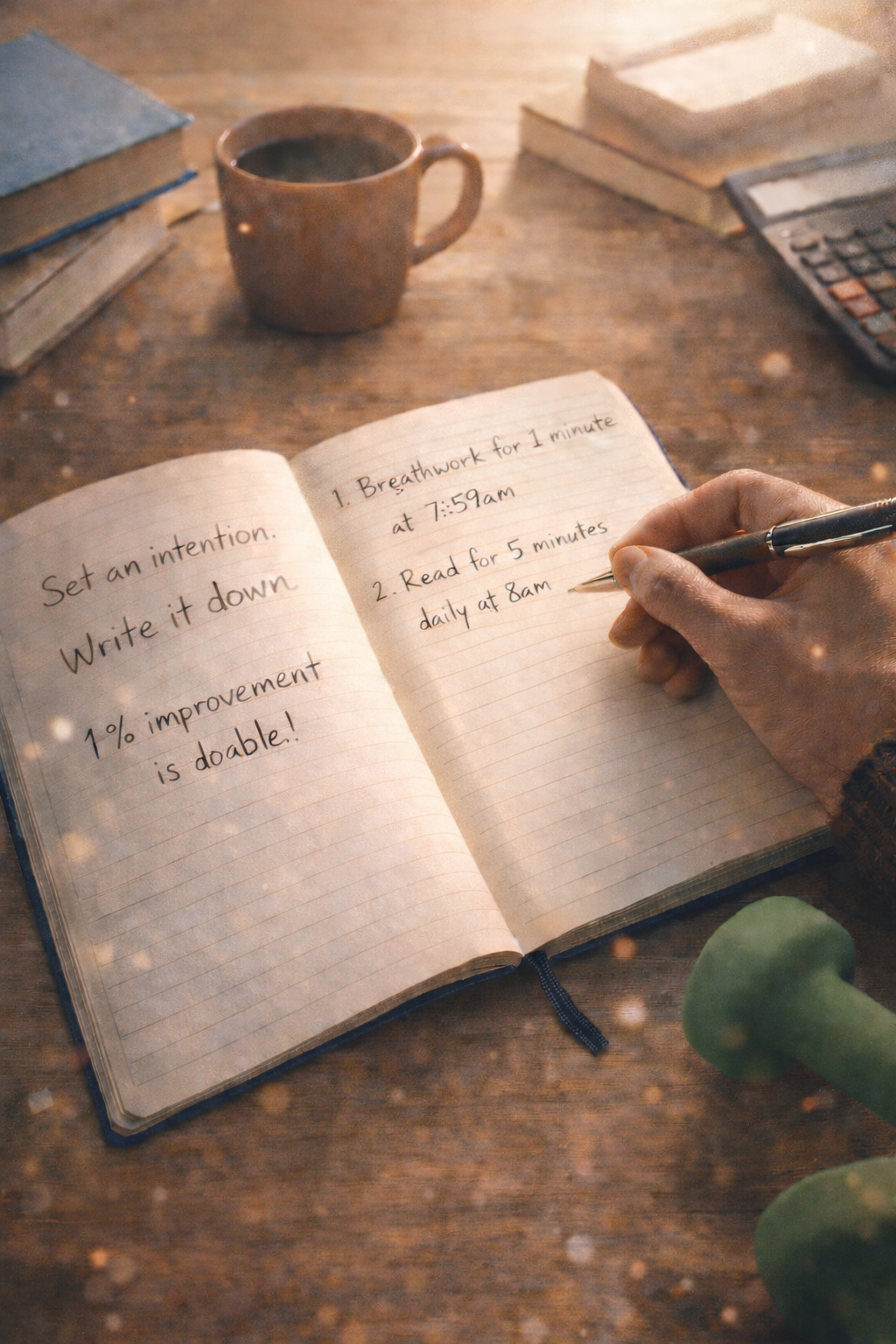
…Then decide.
The word decide comes from the Latin dēcīdere, meaning to cut off. To decide is to cut off other options. Once you decide, the debate stops.
From there, confidence becomes possible. Confidence comes from confidere, to trust. Not blind trust, but trust built on follow-through.
Start small. Smaller than you think.
This is where most people go wrong. They overcomplicate things and they take on too much.
Instead, make it simple. Simple does not mean easy. It means easily do-able.
Start with one action… One pushup. One page. One single minute of focused breathing.
When you repeat a small action consistently, your brain receives a signal that says, “This matters. Save this.” And then it lays down a new connection. This is neuroplasticity!
You’ve undoubtedly heard it before… “Neurons that fire together wire together.”
Each repetition literally strengthens the connection. The brain uses a lot of energy, 20% of our calories in fact and because it’s expensive to run it is designed to find ways to make new repeated actions cheaper – meaning requiring less effort, and less resistance.
Consistency beats motivation.
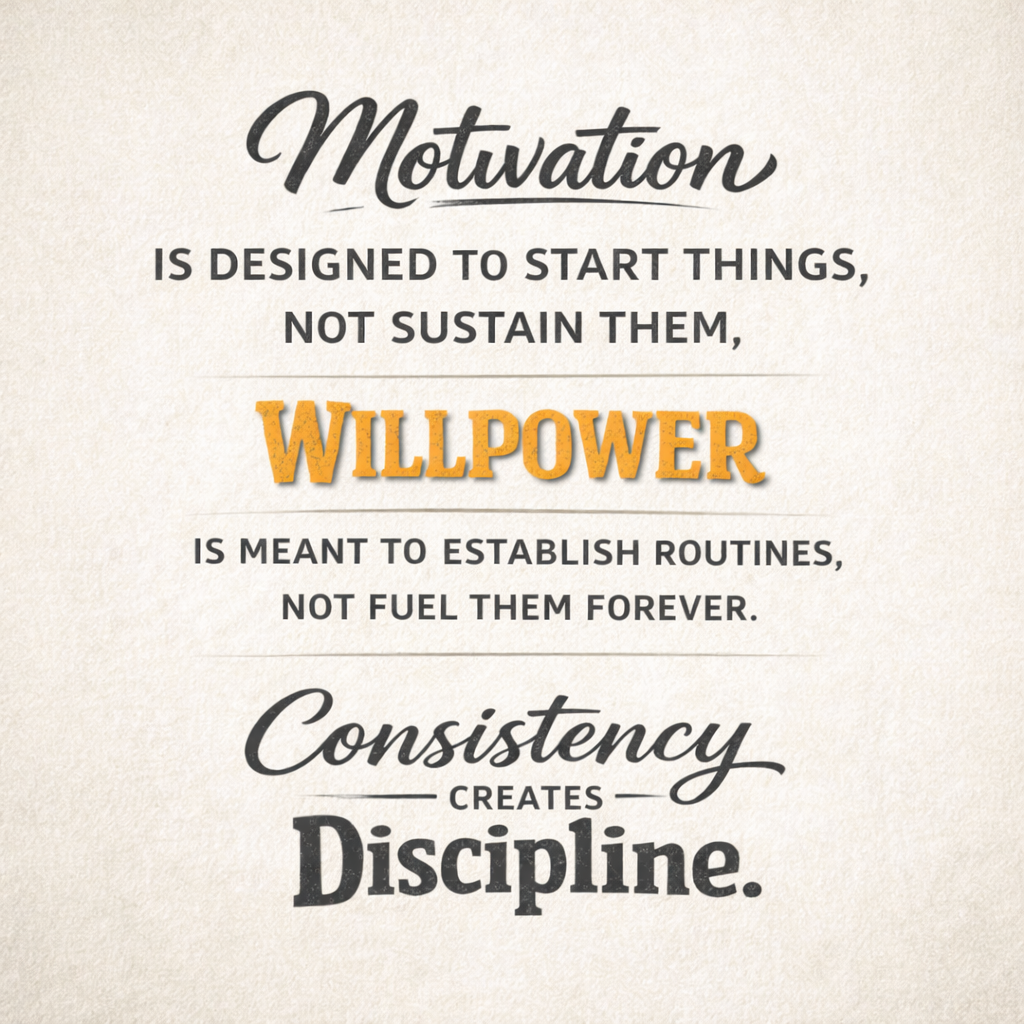
Motivation is designed to start things, not sustain them. Willpower is meant to establish routines, not fuel them forever.
Consistency creates discipline.
Discipline means choosing once, and removing the need to choose again. It is a behavior that no longer requires excitement.
Small Actions Change Identity
Believe it or not, your brain treats new behaviors as potential threats (because of how it requires energy). However, with repetition, that threat fades. Stress decreases, confidence increases, and soon the new action actually feels incomplete if you skip it. That is when identity begins to shift!
“I am someone who exercises.” “I am someone who reads.” “I am someone who shows up.”
Behavior aligned with identity requires far less effort and the science proves this.
One pushup becomes something bigger.
Not because you forced it, but because the brain cooperates.
Once a habit is established, the brain prefers completion. A warm-up flows into a workout and stopping early feels strange.
That one pushup becomes two. Then five pushups plus a sit-up. Then a routine emerges because of consistency. Keep showing up and you’ll continue to strengthen your neural pathways – which WILL make showing up easier and easier!
This way of establishing a new routine or discipline is not through willpower but through wiring.
Final thought
Old pathways weaken when they are no longer used, and new ones strengthen when they are repeated.
Show up for yourself, and especially on the days you do not feel like it. Aim for just 1% improvement and watch that compound. You’ll be so pleasantly surprised at how the process unfolds and how your self-confidence grows because you earned your own trust! You’re tapping into the alignment and meaning behind the intentions and that’s how change becomes sustainable.
In the next post, we’ll explore why effort itself eventually becomes satisfying, and why choosing slightly hard things is often the missing ingredient.
Email me at the end of February and tell me how it’s going. I’d love to hear what trails you are building.
